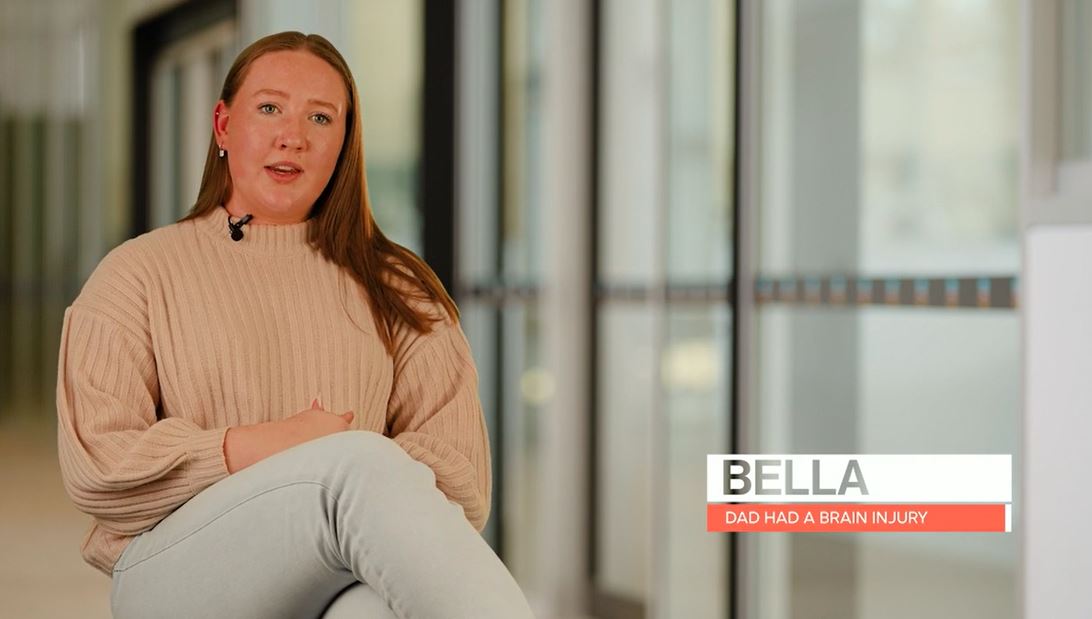
Bella was 12 years old when her Dad had his brain injury.
Brain injury: Aneurysm
When: 25th May 2017
Length of time in ICU: 3 weeks
Watch Bella’s story (XX min)
My Story
On May the 25th 2017, my life changed in a way that would soon be the ‘new normal’.
It started like a normal day. My brother and I went off to school, Mum had a meeting, so my Dad picked us up.
We were outside when Dad got “the worst headache of his life”.
He never gets headaches.
So, I rushed inside with tears streaming down my face trying to find a phone to call someone and keep my brother inside so he didn’t have to see Dad so fragile.
That was the last normal moment for me for a while.
I gave Dad the phone to ring the ambulance. He was barely keeping awake. Ambulances showed up. My brother and I went next door. My godparents came to get us. I couldn’t sleep that night. Mum came home from the hospital and got us at 2am. We went home.
The next few days went in flashes.
We had everyone at our house. Aunties, uncles and grandparents. Every time I came out of my room, they were there. But I wasn’t allowed to see Dad because my Mum was told my Dad may not survive and she didn’t want us to have bad memories about what we saw or experienced.
Having family always around us was a distraction, it was a disguise of normal, except for one thing, Dad wasn’t sitting at the head of that table drinking his coffee when I woke up every morning.
The week that followed my dad’s brain injury, I had flash backs of Dad getting sent away in the ambulance. Except, my imagination started changing the ending of the story.
Sometimes he survived, sometimes he forgot who I was, and the worst part of the week was when I convinced myself that my Dad was no longer coming home.
Ever.
You need to understand that the only reason I thought this, was because no one was telling us anything. The answer was always, “your Dad’s going to be fine in time”. There was no reassurance that he was actually okay and was going to live and I could tell by their faces that he wasn’t fine.
I pushed to go see Dad and I finally won.
He was in the ICU with cords coming out of his head. His face was a pale cream colour. He was so still, it was unnatural. The nurses told me and my brother to speak to him, but I couldn’t.
There was no way that that was my Dad.
We got dragged out of that room after 5 minutes and then after that, I didn’t see him for a few more days. By this time, I was allowed in the hospital. Endless people walked in and out of that room to see Dad. Family and friends from all over the Australia came to see him and this made me uneasy because I knew how much effort and time they took, some drove 5 hours, to come over and I thought that meant the worst for Dad.
He was in ICU for 3 weeks.
After his surgery to insert a coil which Mum talked to me and my brother about, we was awake and able to communicate with us.
It was confronting.
He wasn’t the same person.
There was something off from him that I didn’t like. It wasn’t that he was weak or fragile and I don’t know how to explain this, but he had changed.
He got moved out of ICU into a ward and then nearly straight into rehabilitation. We got to see him as regularly as possible. But it still wasn’t the same as having him home and having our normal routines. We got to have dinners with him and just sit in his rehab bedroom. Staff tried to make the experiences as normal as possible, and they nearly worked except for one thing.
It wasn’t normal.
The minute you would walk out of the room, Dad would forget you were ever there.
He struggled to walk.
He was always asking for his phone and Ipad. Work was still on his mind.
I now realise that Dads time in hospital and rehab wasn’t going to be the worst of his aneurysm and his brain injury wasn’t going to leave us alone any time soon. The worst part were the first weeks when he was allowed home for good.
Our lives changed again to mould into his new one.
Being patient was the hardest thing ever because all you wanted to do was have a normal conversation with him and there was no way of this happening with the state of his memory. The first night home was just him and Mum. We got sent to our grandparent’s house. Mum did this so that she could change anything in the house that confused him and so that she could inform me and my brother about any strange or different characteristics in Dad. After that night, Mum told us to be really patient with him, that he had a bad memory and he got really tired by the end of the day.
It took me a long time to realise and accept this new Dad.
There is no way to explain it and it might just be because I was a little bit older and was very close with my Dad. But he has never gone back to what he was like pre-aneurysm.
I have grown to love him now, even though sometimes I miss him.
I am always grateful that he is here now.
So, some lessons I learnt over this:
- It’s going to be hard. Having to repeat conversations 4 times a day, constantly remind your loved one or yourself to have to do something that you could consider so simple. Like automatically washing the dishes after tea before we sat and watched TV.
- You need to try to understand what they are going through and try to be in their shoes.
- There isn’t a lot of support for kids. Dad has nurses, doctors, social workers and psychologists around him. I had my Mum. At the time, I needed the updates on Dad and how he was going with details “he’s going to be ok because he was attending rehab and having therapy to help his memory”. My initial coping was to bottle up my emotions to be strong for my brother and family. What I needed was time – time to understand it all and time to talk about it all to my Dad. Give your kids this time.
- The dynamic of the household will change. Especially if you have kids. You will struggle to physically do what you might have previously done pre-brain injury (like driving to get to sport) and the only way to help and care for your children is to do small little things, like go for a walk or to the movies as that means you’re spending time together. Trust me, it means a lot.
- We experienced lots of changes to things we did, like going to the Royal Show. We don’t go camping anymore which we did 10 times a year, we don’t go to places with large crowds because of the noise. For kids, this is hard to understand.
Finally, having those difficult conversations. I know it is going to most probably be really challenging for you or your family to talk to others about the trauma you have been through but don’t forget, you’re not the only one. Your wife, husband, daughter, and mother all had to wait in the ICU or outside your room waiting for the ‘all clear’ from the doctors that you will survive.
Time has helped with our pain, and you don’t need to feel rushed to talk about things because it’s challenging to find the words.
If you don’t know someone with a brain injury, so many people don’t know what it is and what it means for kids or families. Don’t ask someone how they are or if they’re ok because they probably aren’t.