Aphasia is a language disorder that affects how people communicate
It happens when the part of the brain that controls language gets hurt.
A person with aphasia may have a hard time understanding, speaking, reading or writing.
Aphasia does not change intelligence.
There are 2 types of aphasia:
- Expressive – having a hard time producing words or saying what they’re thinking
- Receptive – having a hard time understanding what they hear or read
Imagine you know exactly what you want to say, but the words just don’t come out right or they come out in a funny order. It’s like being asked a question and having all your words stuck, like in a game of scrabble…all mixed up and out of reach. That would be frustrating right?! That’s what people with aphasia often go through every day.
This is what someone with aphasia sounds like…
Aphasia can change someone’s independence, and learning which can be frustrating. Some things may be hard to do, such as:
- Talking with family and friends
- Telling people about their thoughts and feelings
- Understanding what is said and following instructions
- Remembering what was said
- Finding the right words
- Concentrating when someone is talking
- Being able to write or talk
- Understanding jokes
- Feel alone, frustrated or not as confident
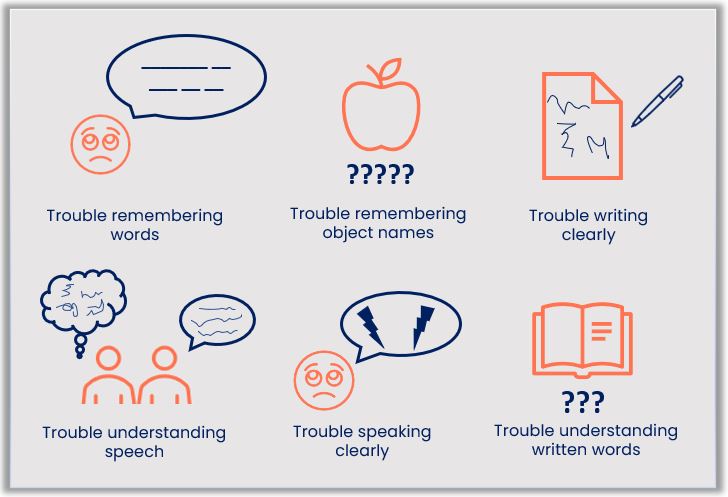
How aphasias affects communication
There are a few different ways aphasia can change communication. Let’s break them down.
Speaking
Some people might know exactly what they want to say but can’t get the words out. It’s like when you have a word ‘on the tip of your tongue’ – only, this happens way more often and can be way harder. Sometimes people might say a different word than the one they meant to say or say the word with the wrong sounds in it.
Understanding Language
People with a brain injury might struggle to understand what others are saying. They might hear the words but have a hard time putting together what they mean, almost like someone is speaking in a foreign language they don’t know.
Reading and Writing
Aphasia can also affect reading and writing. So, reading a text message or even writing a note can be challenging. It’s like all of a sudden letters and words don’t make sense when you read them, or they come out wrong when you try to write them.
Why does aphasia happen?
Aphasia happens when areas of the brain that control language get damaged. There are a couple of main areas in the brain – one helps us form words and sentences, and the other helps us understand them. If one of these areas or the connections between them gets injured, it can make communication really tough.
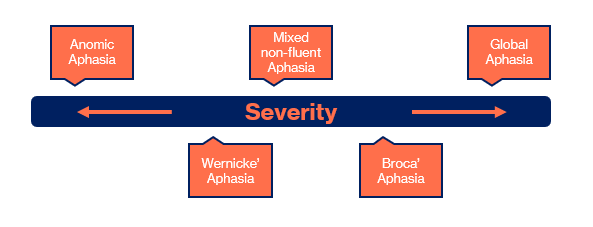
But remember, aphasia is different for everyone. Some people have trouble with just speaking, others with understanding, and some with both. It can be mild and hardly noticeable or severe resulting in the person not being able to communicate out loud at all.
Different types of aphasia
But remember, aphasia is different for everyone. Some people have trouble with just speaking, others with understanding, and some with both. It can be mild and hardly noticeable or severe resulting in the person not being able to communicate out loud at all.
Different types of aphasia
There are a few different types of aphasia, each with their own unique challenges. Here are a few of them:
Non-fluent Aphasia
People with this type know what they want to say but can’t get the words out smoothly. They might speak in short phrases, kind of like texting shorthand — ‘Want water’ instead of ‘I would like a glass of water.’ Reading and writing could be a bit hard too. They can still understand others, though!
Fluent Aphasia
This type is a little different. People with Wernicke’s aphasia can talk easily, but sometimes the words don’t make much sense. It’s like saying ‘couch on the moon’ when they mean ‘let’s go sit outside.’ Understanding others can be tough for them, too and reading and writing might be tricky.
Global Aphasia
This one is more severe. People with global aphasia have lots of trouble with speaking, understanding language and reading and writing. But with support, they can still connect with others through gestures, expressions, and patience.
How can you help someone with aphasia?
- Ask to do different activities such as art and craft, play outdoors, board games
- Involve the person
- Stop distractions like the radio or TV when you are talking with them
- Use simple words and short sentences
- Encourage all types of communication (gesture, pointing, drawing)
- Avoid correcting the language all the time
- Allow lots of time for the person to talk
- Don’t finish their sentences
- Provide hints when they get stuck
- Ask short questions where the person can say yes or no
- Do no pretend when you do not understand
Aphasia can be tough to deal with, but with patience and support, people with aphasia can still connect, express themselves, and share their thoughts. It just takes a bit more time and creativity.
Remember words are powerful, but so are patience and kindness.