Predictions
Predicting the impact of brain injury can be difficult. However, several indicators are used by professionals to help understand and possibly predict the level of a person’s recovery during the first few weeks and months after a brain injury. These include:
- Duration of coma or loss of consciousness
- Glasgow Coma Scale [GCS]
- Length of Post-Traumatic Amnesia (PTA)
- Location(s) and size of bleeding and contusions in the brain
- Rancho Los Amigos Scale (RLAS)
- Mini-Mental Examination
- Functional Independence Measure (FIM)
Duration of coma or loss of consciousness
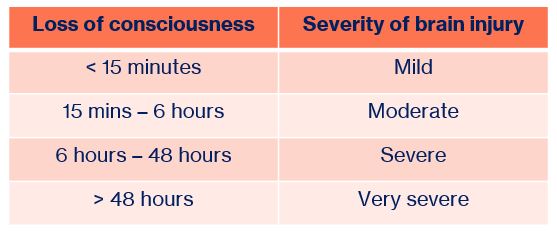
The severity of a brain injury can often be gauged by the duration of time a patient spends in a coma. The following table outlines the correlation between the length of unconsciousness and the corresponding severity of brain injury:
Glasgow Coma Scale (GCS)
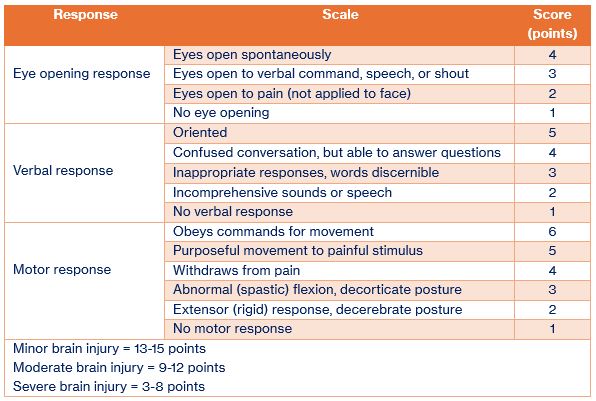
The GCS assesses changes in level of consciousness. There is some co-relation with severity of injury and prognosis, with the GCS divided into 3 sections:
- Eye opening
- Motor response
- Verbal response
Scores are from a minimum of 3 (totally unresponsive) to a maximum of 15 (responding as normal).
Paramedics will do this at the scene of the injury, and it is usually repeated when the person arrives at hospital to determine any changes.
Rancho Los Amigos Scale (RLAS)
RLAS is based on interactive behaviour following acquired brain injury:
- Level 1 = totally unresponsive/no response
- Level 2 = generalised response
- Level 3 = localised response
- Level 4 = confused/agitated
- Level 5 = confused/inapproriate
- Level 6 = confused/appropriate
- Level 7 = automatic/appropriate
- Level 8 = purposeful/appropriate
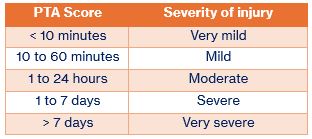
Post-Traumatic Amnesia Scale (PTA)
PTA is a stage of recovery after a traumatic brain injury (TBI) where a person is disorientated or confused and unable to recall new information. PTA testing occurs over several days. The first stage tests ‘orientation’ such as remembering personal memory accurately. This must be passed successfully before proceeding to the second part, assessing ‘memory’ such as remembering new information (photos, name and gesture) consistently over 3 days.
The length of PTA has a correlation to severity of injury and prognosis.
A person needs to pass 3 consecutive days of PTA testing (i.e. 12 out of 12) to be clinically classified as out of the PTA state. A caveat to this is for people who are more than 1 month post injury, they require 1 day of 12/12 to be classified as being emerged from PTA.
Mini-Mental Examination
Scored out of a total of 30. Includes sections testing:
- Orientation
- Registration
- Attention and calculation
- Recall
- Language
- Consciousness
Functional Independence Measure (FIM)
FIM is a scale that is used to measure a person’s ability to function with independence. The FIM score is applied to the following 18 areas: eating, grooming, bathing, dressing (upper body), dressing (lower body), toileting, bladder management, bowel management, transferring (to go from one place to another) in bed, chair and/or wheelchair, transferring on and off a toilet, transferring into and out of a shower, location (moving) for walking or in a wheelchair, and location going up and down stairs, comprehension, expression, social interaction, problem solving and memory.
What does each score mean?
- A score of “1” means “Total Assistance”
- A score of “2” means “Maximal Assistance”
- A score of “3” means “Moderate Assistance”
- A score of “4” means “Minimal Contact Assistance”
- A score of “5” means “Supervision or Set Up”
- A score of “6” means “Modified Independence”
- A score of “7” means “Total Independence”
These individual scores are added to give a score out of 91 for motor items and out of 35 for cognitive items.