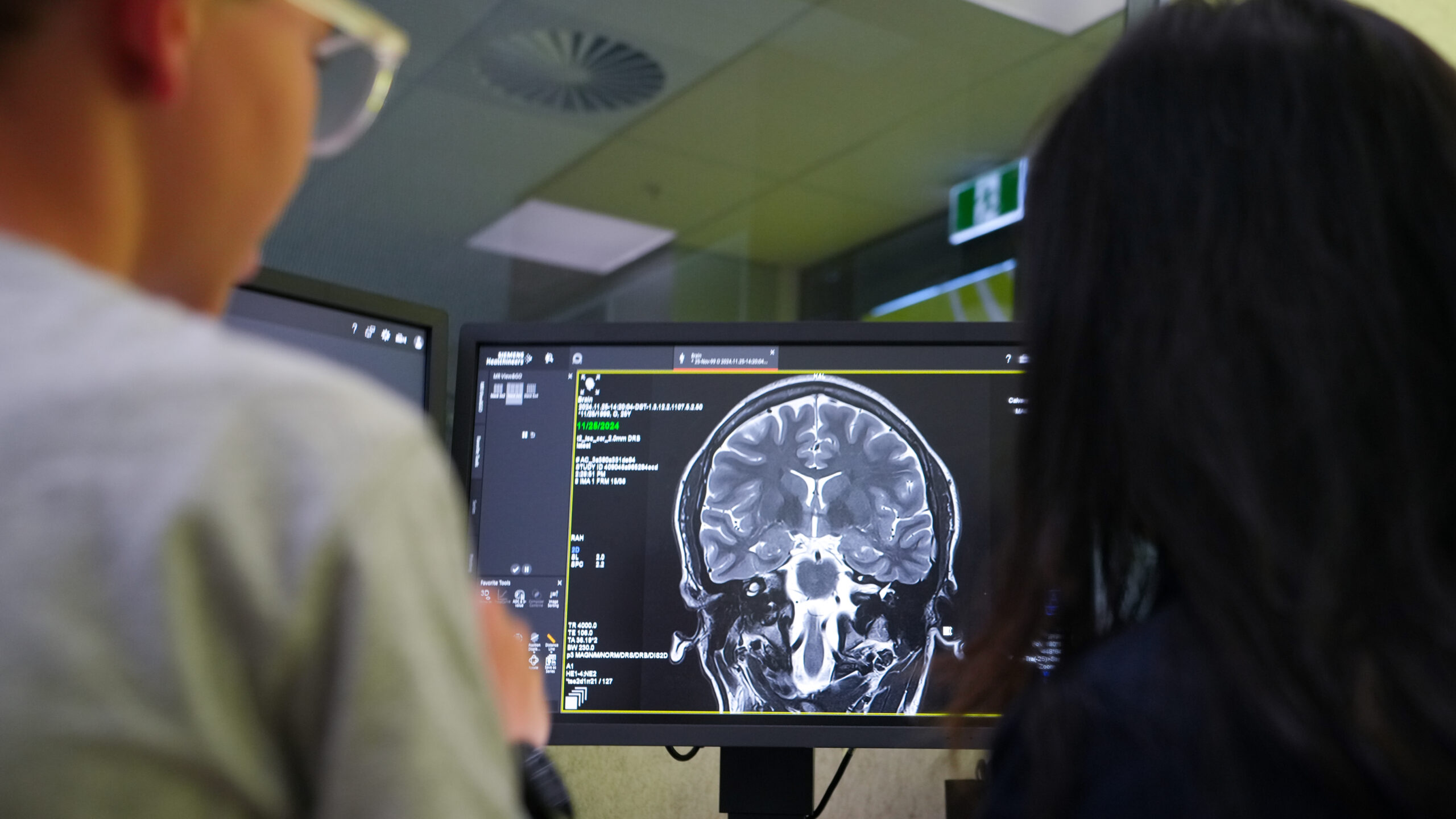
A brain injury is any damage to the brain, sustained after birth, resulting from an external force or internal condition.
Causes of brain injury
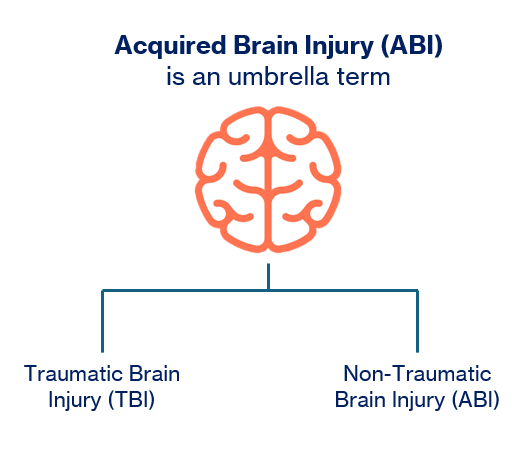
Brain injuries can be caused by a variety of factors, including traumatic or non-traumatic causes. Acquired Brain Injury (ABI) is an umbrella term that encompasses both Traumatic Brain Injury (TBI), and non-traumatic brain injuries, also referred to as an ABI.
A TBI is caused by a blow to the head or by the brain being forced to move rapidly forwards and backwards within the skull through events such as falls, car accidents, or sports injuries. Brain tissue may be bruised, swell, bleed, stretch or tear the nerve fibers (axons).
Effects may be temporary or permanent and range from mild to extremely severe.
There are different types of TBI resulting in closed and open injuries, distinguished by how the injury affects the skull and brain.
An open injury, also known as a penetrating head injury, occurs when an object breaks through the skull and enters the brain.
A closed injury occurs when the brain is injured without any break in the skull, where the brain moves within the skull during the trauma, causing bruising (contusion), tearing of blood vessels (hemorrhage) and axonal shearing (diffuse axonal injury) where nerve fibres stretch, tear or break. A TBI can also be focal, meaning damage is isolated to one specific area of the brain.
Non-traumatic causes, often referred to as Acquired Brain Injuries (ABI), include strokes, infections (like meningitis), deprivation (anoxia) or lack (hypoxia) of oxygen to the brain, brain tumours, and exposure to toxins.
The animation below is tailored to kids but is helpful for adults too. It talks about brain injury: what it is and how a brain injury may change your special person. Knowing all of this can help prepare you for what you may experience with your special person.
Determining brain injury severity
Predicting the impact of brain injury can be difficult. However, professionals look at several diagnostic tests and indicators to help understand and possibly predict the level of recovery your special person may have in the first few weeks or months after injury.
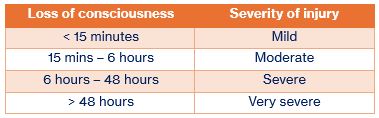
The severity of a brain injury can often be gauged by the duration of time a patient spends in a coma. The following table outlines the correlation between the length of unconsciousness and the corresponding severity of brain injury:
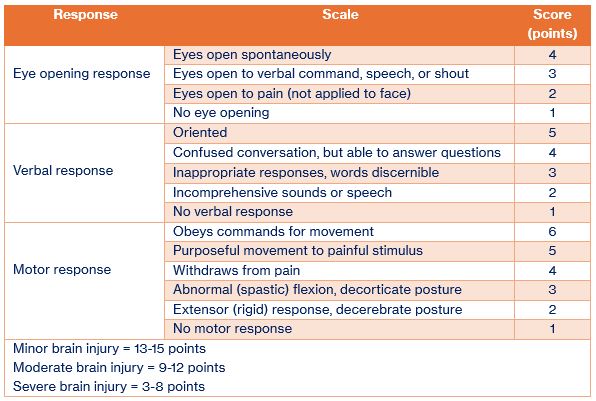
The GCS assesses changes in level of consciousness. There is some co-relation with severity of injury and prognosis, with the GCS divided into 3 sections. Scores are from a minimum of 3 (totally unresponsive) to a maximum of 15 (responding as normal).
Paramedics will do this test at the scene of the injury, and it is usually repeated when the person arrives at hospital to determine any changes.
or
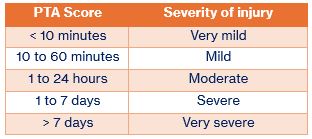
PTA is a stage of recovery after a traumatic brain injury (TBI) where a person is disorientated or confused and unable to recall new information. PTA testing occurs over several days. The first stage tests ‘orientation’ such as remembering personal memory accurately. This must be passed successfully before proceeding to the second part, assessing ‘memory’ such as remembering new information (photos, name and gesture) consistently over 3 days.
The length of PTA has a correlation to severity of injury and prognosis.
A person needs to pass 3 consecutive days of PTA testing (i.e. 12 out of 12) to be clinically classified as out of the PTA state. A caveat to this is for people who are more than 1 month post injury, they require 1 day of 12/12 to be classified as being emerged from PTA.’s
Rancho Los Amigos (RLA) is an interactive scale used to assess how people with traumatic brain injury (TBI) are recovering, from Level 1 (unresponsive) to Level 8 (purposeful appropriate).
Mini-mental is scored out of 30 and tests for orientation, registration, attention and calculation, recall, language and consciousness.
Functional Independence Measure (FIM) is a scale used to measure the ability to function with independence across 18 areas: eating, grooming, bathing, dressing (upper body), dressing (lower body), toileting, bladder management, bowel management, transferring (go from one place to another) in a bed, chair and/or wheelchair, transferring on and off a toilet, transferring into and out of a shower, locomotion (moving) for walking or in a wheelchair, and location going up and down stairs, comprehension, expression, social interaction, problem solving and memory. Each area is scored between 1 (total assistance) and 7 (total independence).
Understanding the brain
Understanding the brain is essential to grasping how it controls nearly every aspect of our lives, from basic functions like breathing and movement to complex tasks like thinking, memory, and emotions. The brain is a highly intricate organ, composed of billions of neurons that communicate through electrical and chemical signals. Each area of the brain is responsible for different functions, and damage to specific parts can lead to various changes. Gaining insight into how the brain works can help us better understand brain injuries, mental health, and the ways we learn and adapt.
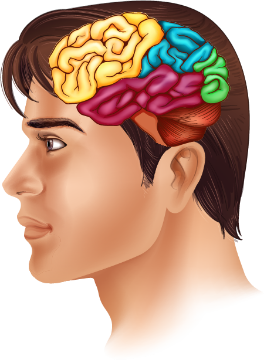
Click on the brain below to learn what each lobe does.
Frontal lobe
Problem solving
Planning & organising
Making judgements
Emotions, behaviour and mood
Personality
Social skills
Temporal lobe
Understanding language
Memory
Emotions
Enjoyment of music
Recognise & identify things we see (faces or objects)
Parietal lobe
Knowing left from right
Sensations (touch, pressure, temperature, pain)
Hearing
Reading
Smelling
Tasting
Occipital lobe
Understanding what we see
Reading and writing
Understanding shapes, colour & distance
.
Brain stem
Breathing
Swallowing
Appetite
Beating of our heart
Body temperature
Staying awake or asleep
Cerebellum
Balance
Coordination
Movement
Regulating feelings and responses
Organising thought
Effects of brain injury
Brain injuries can have profound and wide-ranging effects on an individual’s physical, cognitive, and emotional well-being. Depending on the severity and location of the injury, these effects can vary from mild, temporary symptoms to severe, long-lasting impairments. The impact of a brain injury can extend to every aspect of life, affecting not only the injured person but also their relationships, work, and overall quality of life.
Cognitive Effects
Cognition can be described as a person’s thinking skills. Common problems can vary widely and can include:
Challenges in this area can include a short attention span, being easily distracted, and difficulty focusing on a task, especially if it is long and/or complex.
How can you help?
Minimise distractions (turn off TV)
Encourage regular breaks
Suggest activities that require less attention (listen to music rather than read a book)
Slowed thinking can impact someone’s ability to take in, process and understand information. This means the person may be slow in responding or doing tasks.
How can you help?
Allow more time to think, answer questions or do activities
Speak slowly and clearly
The person may tire very quickly from thinking and doing physical tasks. When tired, other challenges may be more obvious, such as their speech, which may become slurred; their thinking may be slower; or their balance may be unsteady.
How can you help?
Suggest regular breaks
Plan rests between activities
Track fatigue through journal to identify patterns
Plan ahead and be realistic about what can be accomplished
Organise time with the harder tasks done in the morning
The person may retain old memories and well learnt skills, but most people do not remember the brain injury. People can have difficulty learning and remembering new information like appointments, details of conversations, what they’ve been asked to do, or where they may have put items.
How can you help?
Talk calmly
Repeat information
Use a diary, whiteboard, phone or book to record important information
Set up a regular spot for certain items to be stored
Keep to routines
Set up a weekly schedule with planned rest breaks
Set up a weekly schedule with planned rest breaks
The person may have difficulty thinking of ways to solve unfamiliar problems, appear disorganised in their approach, or be unable to plan activities.
How can you help?
Break tasks into small parts
Provide written structure or steps in order
Give prompts
Encourage repetition and practice
Encourage thinking about a task before starting it
The person may break rules and not realise they have made an error. They may ‘hog’ conversations and keep talking when others are no longer interested.
How can you help?
Talk about the activity and the person’s role in it
Provide feedback in a constructive way
Use agreed signals (to leave)
Encourage turn-taking
The person may have some or total unawareness of changes to their thinking and behaviour.
How can you help?
Give time for the person to recognise their challenges
Provide explanations and reasoning
Help identify realistic goals
Ask the person for their feedback and get them to compare it to how they expected to go
Video: Re-Building Brain Power
Watch the video below to understand how you can help your special person re-build brain power when they’ve experienced cognitive changes.
Communication effects
Speaking clearly and fluently is important for others to understand what we say, but brain injuries can affect this in different ways.
Aphasia is a communication disorder that makes it hard for a person to speak, understand language, read, or write. There are 2 types of aphasia: 1) Expressive – having a hard time producing words or saying what they’re thinking, and 2) Receptive – having a hard time understanding what they hear or read. Learn more about aphasia here.
Dysarthria happens when the muscles used for speech are weak, paralyzed, or uncoordinated. It can make speech sound slurred, distorted, or hard to understand.
Verbal dyspraxia occurs when there’s difficulty coordinating the movements of the tongue and facial muscles. Speech may become hesitant, effortful, and inconsistent. For example, someone might be able to say common phrases like “Hi, how are you?” but find it difficult to have a conversation. The Severity of these issues can vary. Some people might occasionally mix up sounds in longer words, like saying “telfon” instead of “telephone.” For others, producing a single sound can take significant effort.
Sometimes, a person may find it hard to understand what is said to them. In severe cases, speech can sound foreign, making conversations nearly impossible to follow. For others, the difficulty may be milder, such as trouble processing long or complex instructions.
For example, they might find it easier to understand a simple request like, “get me a blanket,” compared to a more detailed one like, “head to the passage and go into the left cupboard and get a blanket from the bottom shelf”.
Understanding written information can also be challenging. This might affect their ability to read signs, newspapers, books, or letters.
These difficulties are known as receptive dysphasia.
How can you help?
Avoid overwhelming them
Use simple language
Speak slowly and clearly
Write down important messages
Be patient and give time
Some people may have difficulties finding the right words during conversations or forming sentences to express their thoughts. They might pause for a long time before responding or use incorrect words or sounds. For example, they may mean “plant” but say “grass”.
Writing can also be affected in a similar way, making it hard to compose messages or letters. These challenges can cause significant frustration for some, while others may not realise that their speech or writing is unclear.
This condition is called expressive dysphasia.
How can you help?
Ask yes/no questions
Offer choices
Repeat and clarify
Avoid correcting them too often
Use prompts
Encourage alternative communication (gestures, drawings, writing)
When we communicate, we rely on body language and social skills like taking turns in conversations and using eye contact appropriately. These social aspects are crucial for effective interactions. However, some people may find these skills difficult. They might avoid eye contact, find it hard to start a conversation, or talk excessively. They may also have difficulty controlling their behaviour or words, which can lead to swearing or speaking without thinking.
Physical effects
Brain injuries can lead to a range of physical effects, which might include weakness, coordination problems, balance issues, or changes in sensory perception like vision or hearing. Some individuals may experience chronic headaches, fatigue, or seizures. These physical challenges can significantly impact a person’s ability to perform daily activities and may require rehabilitation such as physical or occupational therapy to regain strength, mobility, and independence. Adjusting to these changes takes time, and having a solid support system is crucial for managing physical recovery.
How to help?
Always check with health professionals before standing or walking with the person
Encourage rest and social time, not just practicing physical movements
Ask health professionals to teach you any activities you can do out of therapy time
Behavioural effects
Behavioural changes are a common consequence of brain injury, and these can sometimes be the most challenging for both the individual and their loved ones. These changes may be subtle or dramatic and may lead to the person saying and doing things that are out of character. Behaviours may include:
The person may have difficulties getting started on a task or moving on from one task to another.
How can you help?
Take some responsibility for directing the person
Provide verbal prompts
Provide a written schedule
Use aids as a reminder (watch, mobile, timer)
The person may do things quickly and without thinking of the consequences.
How can you help?
Suggest the person slows down and thinks before speaking or acting
Provide constructive feedback
Consider safety like road crossing or using sharp objects (knives)
The person may be less able to manage frustrations and be more angry or abrupt in situations that appear out of proportion.
How can you help?
Become aware of triggers and minimise these before behaviours begin
Consider fatigue and if it’s contributing
Give them space
Keep yourself safe
The person may do or say things that are out of character or context, which may be offensive or socially unacceptable. This is often due to a lack of self-awareness or impulse control.
How can you help?
Calmly and privately address the behaviour
Explain behaviour in a non-judgemental way
Offer clear, simple guidance on what is acceptable
Practice situations together
Behaviours may relate to changes in the person’s communication, sensitivities to environments (noise, temperature, crowds, light), changes to vision/hearing or thinking, medications, physical discomfort such as hunger, tiredness, constipation or other emotional needs not being met.
Understanding that these behaviours are symptoms of the injury, not intentional actions, is key to responding with empathy and finding effective ways to manage and modify them.
Psychological effects
Depression, anxiety, and mood swings are common as individuals attempt to come to terms with their new reality. There may be feelings of frustration, grief, or loss due to changes in abilities and independence. These emotional challenges can affect both the individual, you and your family, and it’s important to seek psychological support to address them.
The person may experience persistent and feelings of deep sadness, hopelessness and lack of interest or pleasure in activities.
How can you help?
Listen
Stick to a routine
Encourage exercise
Ask how you can help
Help the person work through their thoughts and feelings
Refer to a psychologist or social worker to provide support and formal counselling
Medication may help. Speak with a Doctor
The person may be excessively worried, fearful or nervous about everyday situations.
How can you help?
Provide reassurance and comfort
Find out their ‘triggers’ so you can reduce them or make them occur less often
Talk about stressful situations in advance to increase sense of safety
Listen
Refer to a doctor, psychologist or social worker to provide support and formal counselling
The person may experience sudden and intense changes in their emotional state, quickly shifting from feeling happy or calm to angry, sad or irritable.
How can you help?
Show understanding, patience and support
Recognise that emotions are often beyond the person’s control
Encourage them to talk about their feelings
Listen without judgement
Offer reassurances and comfort
Identify triggers and strategies to manage them (relaxation, routines)
Create a stable, calm environment
Suggest professional help if mood swings are becoming disruptive
Medical issues
After a brain injury, some medical issues can present, some only emerge over time and can include:
Some people with a brain injury may develop seizures, especially if they have experienced bleeding in the brain (intracerebral hematoma), a penetrating brain injury, or had brain surgery. If someone with a brain injury has a seizure, they are often prescribed medication to reduce the likelihood of another one occurring. Doctors regularly assess whether the medication should continue. It’s important to manage and control seizures, especially if the person plans to drive or operate machinery.
Headaches are common after a brain injury, with tension headaches being the most frequent type. These can typically be managed with pain relief medications and stress management techniques. Some headaches may result from injury to the neck muscles, and physiotherapy can often help alleviate these.
After an injury to the brainstem and/or middle ear, some people may experience dizziness, especially when changing posture. This can impact balance. Physiotherapy exercises and medication can be helpful, but if the dizziness continues, further testing may be needed.
People with a brain injury may experience various vision problems. Some may develop a blind spot in their field of vision, which can be small or extend across half of the visual field (called hemianopia). Others may experience double vision (diplopia) due to an imbalance in eye muscle movement. These visual issues typically cannot be corrected immediately (e.g., with glasses) but often improve gradually over months. Other senses, such as taste, smell, and hearing, may also be affected.
Swallowing difficulties (dysphagia) are common after a brain injury. These issues may arise from muscle weakness and incoordination, reduced consciousness or awareness, and/or difficulty controlling the eating process (such as eating too much too quickly). If needed, a speech pathologist can assess the person’s ability to eat and drink, and arrange any necessary treatments or modified diets. If the swallowing mechanism isn’t functioning properly, there is a risk of inhaling (aspirating) food, fluids, or saliva into the lungs, which could lead to a chest infection.
Bladder and bowel incontinence can sometimes occur as a direct result of a brain injury, but it is more commonly due to a lack of awareness of these bodily functions. As the person regains alertness and awareness, the issue often improves. In the early stages, individuals may also be more vulnerable to bladder infections, which can further affect bladder control. Nurses can help by creating routines to support the person in maintaining continence.
The use of drugs and alcohol can have significant impacts on recovery and overall well-being. These substances can interfere with brain recovery, worsen cognitive and emotional symptoms, and increase the risk of further injury. Alcohol and certain drugs may also affect mood, judgment, and behaviour, making it harder for individuals to manage their condition or follow treatment plans. It’s important for those recovering from a brain injury to avoid substance use and seek professional guidance on maintaining a healthy lifestyle for optimal recovery.
Sexuality can be affected after a brain injury due to changes in hormone levels, emotional responses, behaviour, and physical abilities. These changes may result in shifts in libido, either a decrease or sometimes an increase. Additionally, a brain injury may make it more difficult to adjust to changes in sexual function or intimacy. In most cases, individuals can return to a fulfilling sexual life.
Secondary Effects
Secondary effects of a brain injury refer to additional changes to a person’s life. These changes can include:
Living situations
Fluctuation of social supports and offering of assistance/support from friends or family
Income and ability to work or study
Roles and responsibilities within the home
Relationships and family dynamics
The early stages
Coma
Immediately after a brain injury your special person may be in a coma where they are in a state of unconsciousness and cannot open their eyes or respond in any way to things around them. During this time, the brain is in a critical condition, focusing on healing and stabilising vital functions. For families, this period can be filled with uncertainty, fear and a sense of helplessness as you await signs of improvement. Medical teams closely monitor the patient, providing care and support with the hope that, in time, the person will begin to show signs of recovery and gradually regain consciousness. A coma may last for minutes, hours, days or weeks.
Post-Traumatic Amnesia (PTA)
As people emerge from a coma, they pass through a phase called post-traumatic amnesia (PTA). PTA is a state of confusion and memory loss. During this period, the person may be disoriented, confused, unable to remember recent events, or have difficulty recognizing familiar people and places. Often, people are not fully aware of where they are and what is happening to them. People in PTA may not be speaking, or if they are, their words may not seem to make sense. Although they may remember things from the past, they usually cannot remember things happening now. In other words, there is no ‘continuous memory’ for day-to-day events.
Often, people in PTA perceive their surroundings in a distorted way and this increases their confusion and sometimes their fears. They may appear to imagine things or use items in a way that they are not meant (i.e. using their mobile phone as a hair brush). Their confusion may be worse at night or when they are tired. Fatigue is common in most people with PTA and having too much stimulation, like visitors, loud noises or TV’s can make it worse. It is recommended to keep environments calm and quiet.
PTA can cause agitation and restlessness, resulting in pacing, wandering or intrusiveness. Behaviours can change while in PTA, where a person may respond to directions or requests in a different way than they would have before. They may also be verbally or physically aggressive.
The duration of PTA can vary, lasting from minutes, to weeks or months, and it is often used as an indicator of the severity of the brain injury. While in PTA, it is not possible to predict ongoing functions or problems with speech, memory or cognition. People in PTA may benefit from a specialised brain injury rehabilitation setting to access staff with relevant training, low stimulus and secure environments and behaviour support strategies. Some people in PTA are safer if they sleep on a mattress near the floor and they may need a nurse watching them continuously. People in PTA are not ready for intensive rehabilitation.
While this stage can be frightening and frustrating for both the individual and their loved ones, it is typically a temporary condition that gradually improves as the brain heals.
Tips for family involvement:
Keep stimulation to a minimum. Be quiet, supportive and calming
Keep visitors to a minimum and for short periods. Check with the staff on the recommendations for your special person
Familiar items and photos can be reassuring so bring in a few personal belongings
Keep conversations basic and talk in a calm and reassuring way
If you experience challenging behaviours with your special person, try to distract them or walk away for a short period. Typically, their memory difficulties will result in them not remembering what happened and they may be more settled when you return
Encourage rests or sleeps throughout the day and during your visit. Read any physical signs of tiredness (yawning, slouched posture, heavy eye-lids) and encourage them to lie down
Involve your special person in conversations if you are talking about them to others who are present
Learn about specific brain injuries
Scroll below to find out more about specific brain injuries.
Do you know how your special person sustained their brain injury?