Impact on You
Hope
The impact of a special person’s brain injury cannot be underestimated. Whether you are a partner, relative, friend or companion, your relationship will change and it can feel like your whole world has been turned upside down. The journey ahead may seem daunting, but amidst the uncertainty, hope becomes a powerful ally.
What is hope? Hope is the feeling or belief that something good or positive will happen and believing that it can come true. However, hope is more than just a feeling. It is a source of strength.
Hope helps people navigate the emotional rollercoaster that comes with a brain injury. Holding onto hope can provide the resilience needed to face each day, no matter how challenging. Hope can be linked to optimistic beliefs, faith in God, the special person’s strengths and the support of family.
Hope can encourage you to reach out and build a support network. Connecting with others who have faced similar challenges can offer comfort and practical advice. Sharing stories of recovery and progress can reinforce the belief that improvement is possible.
Every step forward, no matter how small, is a victory. Hope allows people to celebrate these moments, fostering a positive outlook. Recognising and appreciating progress can boost morale and motivate everyone involved. Hope can also create a positive environment for your special person. Your optimism and encouragement can significantly impact their recovery journey.
While the road to recovery may be long, hope keeps the future in sight. It reminds people that there is potential for improvement and that life can still hold joy and fulfilment. Planning for the future with hope can help set realistic goals and expectations.
The healing power of hope
In this video, a family talks about their beliefs of maintaining hope. They reflect on conversations they had with a medical professional who offered the words of “there’s a chance” which gave them strength to keep going, and keep believing. They talk about the power of family and are candid in their emotions, demonstrating the journey they’ve been on, their optimism and resilience.
What have other families said about hope?
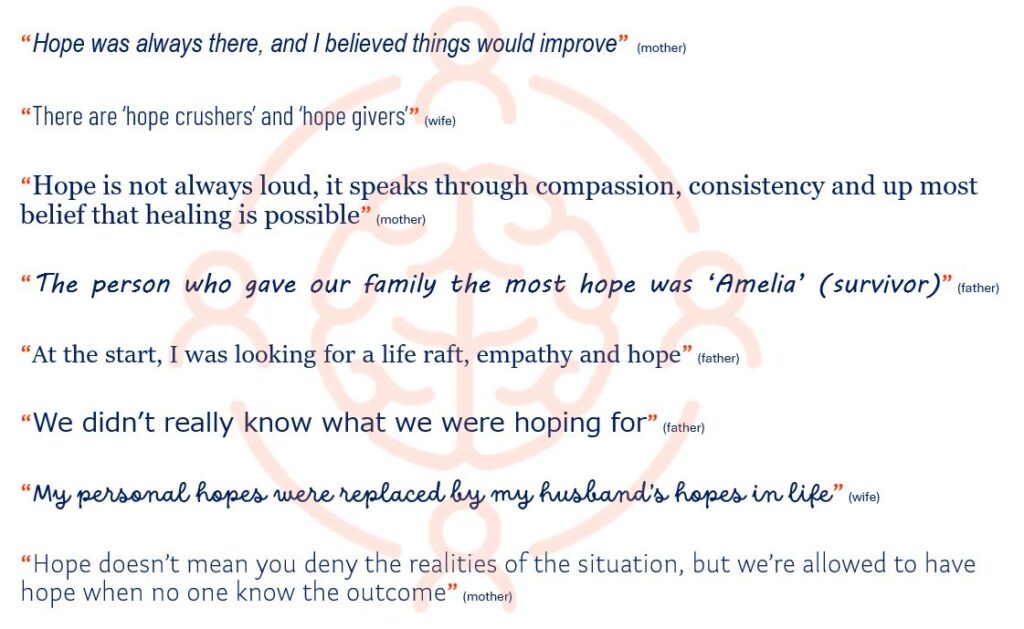
Below are direct quotes from families after a brain injury about what hope means to them:
Grief and ambiguous loss
What is it?
Grief is the deep sadness and pain we feel when we lose someone or something important to us. It’s a natural way our heart reacts to loss. Ambiguous loss is a special kind of grief that often goes unnoticed – this grief doesn’t come with casseroles, flowers or the usual support because others may not fully understand what individuals and families are going through. This type of loss happens when the loss isn’t clear or complete, which can feel confusing and harder to understand because there’s no clear ending, making it tricky to move forward.
All of these experiences are common for families after a brain injury, as you mourn the changes in your special person and the life you once knew. Unlike traditional grief, ambiguous loss occurs because the person is still physically present but may no longer be the same emotionally, cognitively, or behaviourally.
Families may struggle with the uncertainty of not knowing what will return to normal, if at all, and feel conflicted between hope and sorrow. This unique form of grief can create feelings of isolation and confusion, making it vital for families to seek support and acknowledge their mixed emotions as part of the healing process.
The 4 typical types of ambiguous loss after a brain injury, as explained by others who have been where you are, include:
- The loss of you, me and us – this loss relates to the special person and who they once were, the loss of self (you) and the impact on your relationships, and the loss of the couple you once were.
- The loss of security and stability – this loss can affect people in different ways. In close relationships, some may feel they no longer have someone to rely on when challenges come up. In friendships, it can mean a lack of recognition for new insecurities, like emotional ups and downs, financial worries, or uncertainties about the future.
- Loss of connectivity – this is the loss of connection in close relationships, like love and emotional attachment, which can lead to feelings of isolation and loneliness.
- Loss of future – this is feeling uncertain about plans, goals, hopes and dreams that once gave meaning to the relationship.
Working through ambiguous loss requires a process of acceptance and adaptation. It starts with acknowledging the complex emotions — grief, confusion, and even guilt — associated with the ongoing presence of the person who has changed after the brain injury. Recognising that the loss is real, even though it may not fit traditional definitions of loss (such as bereavement), is an important step.
You may experience an oscillation between the emotional pain of the loss and restoration of a new life. To work through these processes, allow yourself time to grieve the loss but also take breaks by focusing on practical tasks, new responsibilities and positive experiences. It’s important to honour both aspects of this process – acknowledge your emotions while also giving yourself permission to live and rebuild, to “shed ones old self and re-establish who or what you will become”.
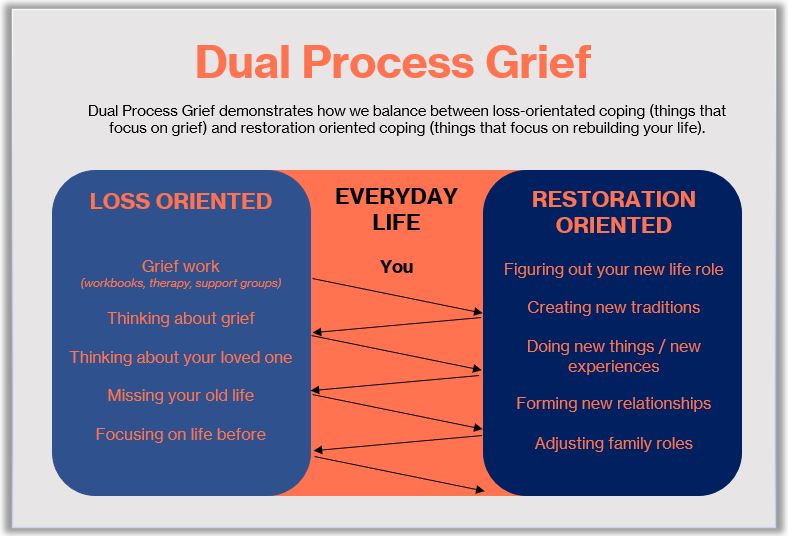
Seeking emotional support through therapy, support groups, or counselling can help process these emotions and provide coping strategies. It’s also helpful to focus on redefining the relationship, finding new ways to connect with and support your special person as they are now. Patience, self-compassion, and focusing on small positive moments can ease the path forward, allowing for a balance between hope and acceptance.
Challenges for partners
The challenges for partners are real as new dynamics enter the relationship, especially over the long-term. Partner’s often take on new caregiving roles which can shift the balance of the relationship, leading to complex and mixed emotions. Common challenges for partners include:
- Taking on extra responsibilities, such as sole wage earner and caregiver
- Impact on intimate / sexual relationships
- Marital instability
- Impact on finances
- Uncertainty about the future
- Communication challenges
- Ambiguous grief and loss
- Loneliness, fear, uncertainty, powerlessness, guilt and shame
- Struggling to connect on the same emotional level as before the injury
- Reflective questioning about decisions you may have made along the journey
The risk of divorce after a brain injury can be a concern for many couples. The facts are, relationships change. To what degree, differs for each couple. Therefore, what support you need will be individual and may change over time once the realities of life and relationship dynamics are known.
Information specific to sex and intimate relationships, please go here.
Challenges with friends
Friendships often change after a brain injury as the impact of the brain injury can alter how your special person interacts with others. They might have challenges with memory, communication, or social cues, making it harder to maintain the same connection. Friends may not fully understand the extent of the injury, leading to frustration or distance. Some friendships may fade, while others evolve as certain friends become more supportive and empathetic, helping you and the special person adjust to your new reality. It can be a time of both loss and discovery, as you learn who truly stands by you during this difficult journey. Common challenges with friends include:
- Increased strength and connection to your close friends
- Some loss of friendships and feelings of isolation
- Difficulties relating to friends after long hospital admissions
- How cognitive, behavioural and emotional changes can impact on social interactions
- How physical changes can impact on mobility issues and where you can go/socialise
If you have a friend trying to support you and they’re not quite getting it right, considering printing this sheet for them.
Emotional support
It is important for you to find and connect to people who are there for you, listen without judgement and can provide support. These people may be part of your existing support networks (family, friends, trusted companion, colleagues), or they may be others who share the same experiences, offering empathy, understanding and practical advice.
If you would like to meet others, considering using our community connection page you can access here.
It is important to communicate your needs openly and seek help when feeling overwhelmed. Linking into formal support such as a psychologist or counsellor may be beneficial.
Practical support
Adjusting to the injury, the changes, and providing care over time can take a toll. It is important to give yourself permission to reach out and accept help as you navigate this challenging journey. There are many sources of support available to explore such as:
- Try and involve friends and family to share responsibilities and take some of the load off you. Often, they want to help if they know how, so tell them
- Link with services and community agencies who provide support and assistance to carers and families. This may be state or national carer services, or peer support groups. Assistance may include counselling, peer groups, tailored support packages (planned respite, cooking, cleaning, assistance with shopping and transport)
- National disability funding schemes such as the National Disability Insurance Scheme (NDIS) which provides funding and support to eligible Australians with disabilities to enhance their independence and quality of life
- Insurances such as Income Protection, Trauma Cover, Superannuation benefits, Compulsory Third Party (CTP)
- National and peak state brain injury services who may have programs, services and other resources to understand brain injury and the impact on carers and families
- Charitable benevolent societies in your state or country who may provide financial assistance to those in need
- If you are employed, check with your employer for leave entitlements or opportunities for flexible working conditions
- Depending on the country you are in, check on any financial government benefits you may be entitled to (such as Centrelink in Australia)
- Carer supports and agencies where you can get carer information and resources
The value of finding information
In this video, Dave talks about the value in finding the information you need to understand brain injury.
Who is caring for you?!?
Unless someone has experienced or closely knows someone with a brain injury, they cannot truly understand what you and your family are going through. You will enter survival mode, feeling overwhelmed with thoughts like, “Oh my god, I’m so scared. What does this mean for my special person’s life, and what does it mean for mine?” Your life and your family’s lives may seem to revolve entirely around your special person’s goals, thoughts, and behaviours.
Looking after yourself
If you have moved into a caring role, it’s essential to prioritise your own wellbeing. Caring for someone with a brain injury can be emotionally and physically exhausting, so self-care is not a luxury – it’s a necessity!
‘Looking after yourself’ is a concept that has individual meaning. Sometimes it can mean taking time out, having a day off visiting hospital, meeting with friends for a coffee or planning future moments or events. Sometimes it’s just getting out of bed in the morning to face the day!
Taking time for yourself, even in small ways, can help you recharge and maintain your mental and physical health. How can you do this?
- Maintain your hope
- Be kind to yourself
- Ask for help when you need it
- Take short breaks and schedule regular time for yourself to undertake your hobbies and interests
- Regular exercise
- Keep up social connections and maintain friendships
- Maintain your own identity
- Healthy eating
- Sufficient sleep
- Meditation
- See your doctor regularly about your physical and emotional health
- Use good time management and set priorities, as much as you can, to allow for practicalities of family life
- Get trained on how to care for your special person to reduce physical risk of injury
- Attend carer support groups
- Acknowledge your feelings and accept them as a natural part of your journey. If you have been feeling sad, low mood or anxious for more than a few weeks, talk to a professional such as your doctor or psychologist, as early as possible, as this may be signs of depression. Suppressing or denying your feelings will not make them go away
- Be aware of becoming socially isolated
- Plan for the future
- Set boundaries (digital, physical, time, emotional, intellectual, material) to ensure your self-care and wellbeing is prioritised
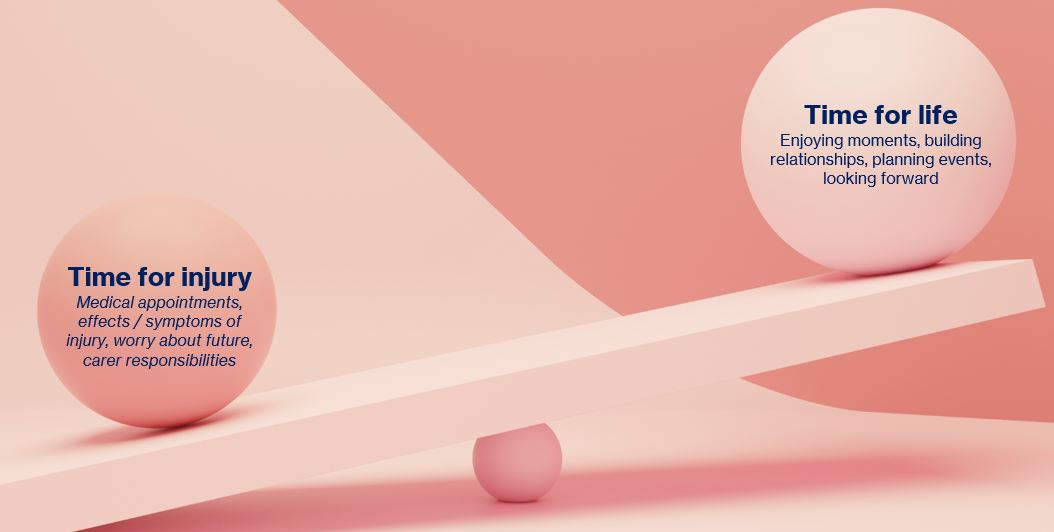
Attempt to balance Time for Life and Time for Injury as you experience the emotional and practical tension between moving forward with life and managing the realities of recovery. Balancing both is key to supporting your wellbeing, identity, and hope after brain injury.
Developing a positive mindset
In this video, Liz talks about the benefits of developing a positive mindset, living in the moment and for her, the benefits of not thinking too far ahead. Liz focused on having fun with her son and enjoyed the small achievements he was making.
Becoming a carer
Supporting a special person with a brain injury
Carers and family members approach supporting a special person’s recovery in different ways. Sometimes the decision to take on the carer role is not a conscious thought at all. For carers, it’s often felt that the attention is understandably on the person with the brain injury and it can feel that there is no time for your, or your family’s needs (i.e. children).
Know that your needs are important!
Some people take on the majority of care. Some seek to maintain their pre-existing relationships as spouse/partner/friend and delegate the care externally.
The range of care can include:
- Helping the person to stay involved with hobbies, activities and interests they enjoyed before their brain injury
- Working with healthcare professionals and support agencies to meet the person’s physical, psychological, emotional and support needs
- Helping the person with daily activities such as personal care (getting dressed or showering), household chores, preparing meals, parenting roles and responsibilities, attending appointments, or managing their medications
- Supporting changes to behaviour or personality
- Helping the person physically, such as their mobility or ability to get in and out of bed
Maximising independence
To help maintain as much of your special person’s independence as possible, encourage them to do as much as they can for themselves. If you need to help, do it with them and not for them as this will encourage maximum independence and self-esteem.
Keeping a positive approach to skills and abilities will aid in building your special person’s confidence, by:
- Seeing the person, not just their brain injury
- Identify the strengths of your special person
- Focus on what they can do, not what they can’t
- Help them set realistic goals and support them to attempt to achieve them
- Support your special person to self-advocate for the support or treatment they would like
- Build communities around your special person where they feel understood, accepted and included
- Be flexible and patient, remember no one is perfect
- Put yourself in their shoes to understand what they may be experiencing and how they feel
- Be sensitive and provide encouragement
- Support meaningful activities and tasks
- Communicate with, and include the person as much as possible
- Break down big problems into small steps and solve them one-at-a-time
- Think broadly of all possible solutions before choosing one that fits the situation
- Try not to speak for the person
- Plan regular quality time together
- Consider the ‘dignity of risk’ and balancing risk and independence
Setting boundaries
When a special person in your family experiences a brain injury, roles, routines, and relationships often change, sometimes suddenly and dramatically. While supporting your special person is important, it’s equally essential to protect your own wellbeing. Setting healthy boundaries helps everyone in the family adjust and cope more effectively.
What are boundaries?
Boundaries are the limits we set to protect our emotional, mental, and physical health. They help define what we are comfortable with, and what we’re not. After a brain injury, boundaries can help:
- Manage stress and prevent burnout
- Clarify new family roles and expectations
- Support healthier communication
- Create space for healing, for both the injured person and family members
Why boundaries matter after brain injury
Brain injury can change a person’s behaviour, mood, memory, and decision-making. These changes may lead to misunderstandings, emotional strain, or shifts in family dynamics. You may feel pressure to always be available or to take on new responsibilities you didn’t expect. Boundaries help prevent overwhelm and make care more sustainable. Examples of healthy boundaries are:
- Emotional boundaries: “I need time to process my feelings before we talk more about this”
- Time boundaries: “I’m available to help until 6 p.m., then I need to rest”
- Personal space: “I need some quiet time in the mornings to recharge”
- Verbal boundaries: “I want to help, but I can’t continue this conversation if I’m being spoken to like that. Let’s take a break and try again when we’re both feeling calmer”
- Caregiving limits: “I can help with meals and appointments, but I need support for personal care tasks”
- Social boundaries: “Thanks for the invite, I’m going to sit this one out. I’ve been needing some quiet time, but I really appreciate you thinking of me”
Signs you may need to set boundaries
If you relate to several of these signs, it may be time to set boundaries. Start setting small, respectful boundaries to protect your time, energy and wellbeing:
- You often feel guilty or pressured
- You’re frequently angry, resentful or irritated with a person or situation
- You begin to dread certain conversations, visits or requests
- You experience stress symptoms like headaches, fatigue or trouble sleeping
- You feel tense or uncomfortable in someone’s presence
- You’re being spoken to disrespectfully or treated in ways that cross your values
- You often find yourself in the middle of others’ drama
- Your own needs and time are consistently overlooks in favour of others’
- You feel like you’re “on call” 24/7, with no time to rest or care for yourself
- You find it difficult to speak up
- You avoid conflict
- You agree with others just to make them happy
- You say “yes” when you don’t want to
- You find it hard to make decisions
Tips for setting boundaries
- Be clear and kind = use calm, respectful language when expressing your limits. Being firm doesn’t mean being harsh.
- Stay consistent = boundaries only work if they’re maintained over time. Follow through gently but firmly.
- Accept that guilt may arise = it’s natural to feel guilty when setting boundaries, but taking care of yourself is not selfish; it’s necessary.
- Encourage team support = involve other family members or professionals. You don’t have to manage everything alone.
- Adapt as needed = brain injury recovery is ongoing. Your boundaries may change as needs evolve so check in with yourself regularly.
Talking about boundaries
Conversations about boundaries can be emotional. Try starting with:
- “I care about you, and I want to support you in a way that works for both of us.”
- “Things are different now, and we’re both adjusting. Let’s talk about what we each need.”
Get support
Setting boundaries isn’t always easy, especially if you’re feeling overwhelmed, isolated, or unsure what’s “okay” to say no to. You don’t have to figure it out alone. Talk to a social worker, counsellor, or your healthcare team. Support groups and mental health professionals can also help you build confidence in protecting your time and energy.
Videos
The value of emotional support
In this video, Jack and Sam (sons) and Phill (husband) talk about the value of providing their mum/wife with emotional support during her hospital admission
Building independence together
In this video, Geoff talks about his relationship and how they – together – were able to build his wife’s independence.
Physical support: not a sprint, it’s a marathon
In this video, Liz talks about her son’s recovery being a marathon, not a sprint.